
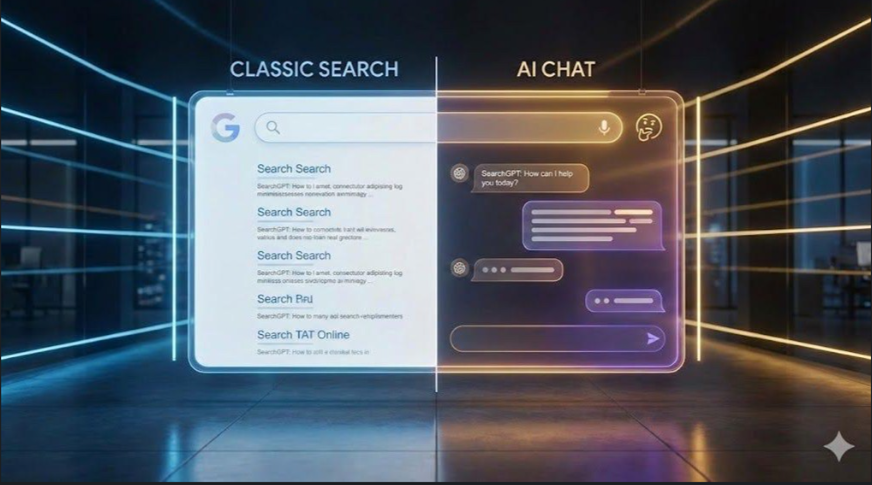
AI Mode passed a billion monthly users last week, exactly one year after it launched. Queries inside it are doubling every quarter. And on Google’s own data, the average AI Mode query is much longer than a traditional Google search.
At the newest Keynote I/O, Liz Reid pointed to one example on stage: “Can you build an itinerary for a hiking day trip near me with great views and dog friendly trails and a lunch spot with convenient parking?.” That sentence alone has more constraints in it than the average PPC account has audience signals.
In just a year, Google search split in two.
Some users are still typing “summer vacation 2026.” Some users are now typing the paragraph above. Both behaviors are growing. Both convert. And almost no Google Ads account in the wild is built for both at the same time.
What changed underneath the box.
For twenty-five years, the search box assumed you’d strip your thoughts down to keywords before you typed. We trained a generation of users to translate “I need a family SUV under $40K with third-row seating, decent mileage, available within 30 miles” into “mid-size suv 2026” and then sort through ten links to do the actual filtering ourselves.
The new box assumes the opposite. Type the paragraph. Speak the paragraph. Add a screenshot of the car you saw at your neighbor’s house. The system now does the filtering.
The keyword-stripping behavior isn’t completely gone. People still search for “pizza near me” when they want pizza near them. But the questions that used to take seven separate searches and a spreadsheet are collapsing into one prompt.
That’s where the doubling-every-quarter growth is coming from. Not from people searching the same things more often, but from people finally being able to ask the question they actually had.
What this means for paid search accounts.
The instinct in most agencies right now will be to chase the long-tail with more keywords. That instinct is wrong, or at least incomplete. You can’t enumerate a query like the Philly-vacation one. The keyword list doesn’t exist that covers “under a 4-hour drive,” “fits a $3,000 budget,” and “outdoor hiking and a beach” as a single combined intent. The match types weren’t designed for it.
What does cover it is a broad match keyword paired with a clean conversion signal, strong audience data, and a well crafted landing page that actually contains the answers to the constraints inside the query.
The auction is increasingly being decided by whether your content can satisfy a sentence rather than whether your bid can match a phrase. Accounts still organized around tight exact-match SKAGs are going to look great on paper and quietly miss the half of traffic that’s now arriving as full sentences.
The other thing that breaks: search query reporting. When the average query triples in length and starts including budget, geography, dietary restrictions, kid ages, and preferred brands all in one breath, the “top search terms” table stops being useful.
You can’t pattern-match against a list of three word phrases when the queries are three sentences. The skill becomes reading what’s changing in aggregate; themes, modifiers, constraint types, rather than mining individual queries for negatives.
The short answer.
Half of your audience still types “best crm software.” The other half is now typing “we’re a 30 person services firm that just outgrew HubSpot Free, need something with decent reporting and Slack integration, budget around $80 a seat, what should we be looking at?” Your account needs to win both. Most accounts are built for just one of them.
At Carbon, we’re seeing this shift play out in real time across both new business audits and the accounts we already manage every day. Some brands are still optimized for the old search world with tight keyword groupings, exact-match control, and short-query intent. Others are beginning to capture the newer, conversational discovery behavior emerging through AI Mode and broad-match learning systems. The gap between those two approaches is widening fast.
Our focus isn’t just adapting to where search is going, it’s helping clients operate effectively across both realities at once. That means rebuilding account structures, refining audience and conversion signals, evolving landing page content, and aligning SEO, media, and creative around how people actually ask questions now. Because the future of search isn’t replacing keywords with prompts. it’s the coexistence of both. And the brands that win will be the ones prepared for the full spectrum of intent, from two-word searches to fully formed conversations.